Showing posts with label Education. Show all posts

Monday, September 26, 2011

How to Prepare Yourself to be a #Social #Strategist from #College

As Social Media is a rising platform for marketing, it is also an increasingly popular career path for many graduating students, but what does it take to become a social strategist and how can you prepare early?

Information from an interesting infographic by Valtier Creative:
http://mashable.com/2011/09/24/social-media-career/

Here are some things to look out for as you begin/ finish up your college career:

1. What major should I be?
- 46% of Social Strategists hold a Communication and 40% hold Marketing degrees.
- 58% of existing Social Strategists say that what makes them successful is that they are multi-disciplinary and can wear many hats. i.e. it could be a good idea for a Liberal Arts education.
Take your pick.

2. Be familiar with your numbers, and argue it with a story
- One of the most important aspect in becoming a good social strategist is the skill in measuring and reporting ROI (as well as producing them of course.) 

What to do in college:
So some great courses to take if they aren't already in your requirement list, are statistics, introduction to business management, etc. They will also help you get used to very basic but useful tools like excel.

Other courses such as Logic and Reasoning (philosophy), or creative writing will help you make better reports + proposals!

3. Work on your leadership and social skills
- To be a social strategist, you must be able to manage a team, work with agencies, external/internal stakeholders, as well as be able to teach others via workshops and training. 

What to do in college:
Get some experience via student groups, or start your own business while you're in college! (Or take classes like Organizational Behavior, or intro to public relations/corporate relations!)

40

Friday, June 3, 2011

6 Reasons Why Internet/Social Media Should be Used in Classrooms

It's no secret that students with laptops in class, with the excuse of "I type notes faster on my computer," are surfing away on the Internet while trying to look focused (or in some cases they won't even bother.)  Many professors, or parents even, have long debated whether Internet use in class is distracting or helpful at all.

Of course, very soon professors realize that students are IM-ing or Facebook-ing more often than typing down everything they say, so some professors have gone as far as to prohibit laptop use AT ALL, (or try to ;) ).

But here's how I see it. If put to good use, as most over-achieving college students or at least ones with a tiny sense of pride do, Internet actually facilitates learning in the classroom. I mean who enjoys being embarrassed in front of the class when asked a question you don't know the answer to?

1. Internet can be your quick tutor
Unfortunately, not every student are prepared for class every single time. Some oversleep their alarm clock for the early 30 minutes read before class; some too wasted from last night to care until the embarrassment of class discussion; some honestly just forgot about it.

But as a good college class should be, the content covered is always beyond the textbook. The textbook is the basis of class discussion/analysis, so I didn't read it...now what?


I can either
1.) Sit here and day dream to the gibberish in the background, 
2.) leave, or 
3.) I can quickly sparknotes/google it. 

Option 3 allows me to have the basic understanding to what the professor is going on about. I mean my parents DID pay god knows how much money for me to be here.

2. Participation in Class
Don't you hate that kid on your left that just rambles on and on about nothing hoping that the teacher won't notice that he didn't read the material? Yeah, some would prefer to be silent than to be him With the aid of Internet however as mentioned above, you get the gist of the material you didn't read, and if you listened really carefully to what your professor said, it's much easier to join in with some useful comments. i.e. Internet can help encourage participation (apart from the scenario where you're just completely indulged in last night's pictures someone just posted on Facebook.)


3. Imagination and room for debate
Many students like to look up topics or controversial arguments online brought up by the professor during class. What then happens is you find a completely opposite view, feel smart, and challenge the professor on what he just said. This usually prompts a fairly insightful debate in class that helps you use information you already know at hand.


4. Keeping my attention
Personally, I have quite a short attention span. I have to be doing quite a few things at the same time for me not to fall asleep, so staring attentively at the professor isn't a choice for me. Random clicks on Facebook or Google actually helps me focus in class. Anyone feel the same way?

5. Information sharing
Many professors actually provide relevant, timely, or funny materials that students enjoy. I've tweeted many inspiring quotes, videos, and food-for-thought type content I got from class. This helps share the knowledge to fellow students and encourage learning.

6. Calming my worried mother who still forgets the time difference
Relevant to most international students. Many times my mother who lives in Hong Kong forgets the time difference and decides to Skype me while I'm in class. She hasn't reached me for a while and types "pick up! where are you!" And you know how mothers are when they can't reach you...so with Internet in class, you can easily answer the call, turn on the webcam to show her you're listening attentively in class and thus calm her and have her feel safe for another week or two (i.e. she won't call you.)

Friday, May 13, 2011

6 Qualities of an Outstanding Professor

Coming to Boston from a private high school in Hong Kong, I had extremely high expectations for the quality of professors at BU. Of course, BU is an ENORMOUS school, so there are bound to be some good professors and not so good ones. 

What I've come to realize is that not all professors understand the art of teaching. They are all outstanding in their subject area, but to teach it to someone else is a completely different story.

Funny this happens during my senior year, but this semester I had a chance to see the best of it and the worst of it at the same time.

Never have I taken more than 10 minutes of my time to fill in "1" bubbles down the entire column (1 = Very poor, 5 = Excellent,) I guess that's a change.

So here's a basic comparison of the two anonymous professors. 

So what went wrong here with professor B? Almost everything to be honest... Not very conventional, but the student (not me of course =]) who collected the class evaluations decided to read a bunch of them out loud, and *surprisingly*, all the bubbles were filled in on the "1" column, and all the written comments were very negative.

Professor A was so loved that at the end of the last class, students voluntarily waited for her to finish packing, lined up at the door to express their gratitude with a huge hug. True story.

Ranting. A lot of ranting I know. 
To clear things up, here are 6 qualities I look for in a good professor.

1. A humble attitude - As a professor, you are hired because of your qualifications. As students, we KNOW you're good at your subject matter. You don't need to remind us every class that you have a Ph.D. Learning is a life time career by the way. Many professor admit to it, they learn from students as much as they learn from them.

2. Be strict, but don't be a robot - It is always hard to maintain a good balance between being too strict or too lenient, but part of the fun of teaching is that the rules are never completely rigid. Students are never the same, and it's important to tailor the class to different groups. Attendance is mandatory, we understand that. But it's hard to us to understand why you take off 10% of our final grade when we were put in a hospital for a week after a brutal car crash.

3. You're busy, but know that we are too - It's absolutely ANNOYING when professor say "I'll have your papers end of this week, or maybe the next or the one after. I have a LOT of things to do you know. You'll get it when you get it." Many students here at BU overload classes AND have 2 internships on top of a part-time job, but we're not allowed to say "you'll get my assignment when you get it" now are we? Why would we do our assignments if you don't do your job?

4. Open mindedness - Most professors are open to new ideas, or a challenge to old ones. Especially in the field of communications, it's important to follow trends and rising theories, (there's an awesome New Media class a BU). Debates are mind provoking, and to in my opinion, best way to learn. It's easier to convince students with arguments than just telling them they're wrong.

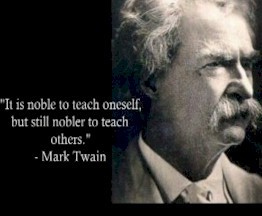
"It is not so much what is poured into the student, but what is planted that really counts."

5. It's about listening and quality feedback - Just as media is no longer a one-way street, neither is teaching. We are no longer in an era where we just sit and absorb information, because chances are we can get whatever information you are just feeding us from the Internet or books.

"Teach a child how to think, not what to think." - Sidney Sugarman


6. PASSION - Not just about the subject, but about teaching! As a professor, you basically hold the power to change the world. Your attitudes, values, knowledge and etc. is passed on to the next generation.


There are many reasons why certain people become teachers. Great vacations, get time to work on personal projects such as books, research or even your own company while teaching. Some people just do it because that's the best they got. But whatever reason it was, know that you are preparing the future pillars of the world, shaping and inspiring their thoughts.

"The mediocre teacher tells. The good teacher explains. The superior teacher demonstrates. The great teacher inspires." - William Ward


Thursday, March 31, 2011

Facebook Tetris - Rank up your brain

Look around the classroom, the study lounges, your friends' laptop screens; Facebook Tetris Battle is the new in thing for Asians. My friends and I have been Tetris battling each other at night for hours (...sad, I know, but that’s what addiction is.) So I decided to do a little research this addictive game I’m fighting against, and what I found was that playing Tetris increases brain efficiency!

Using brain imaging technology, researchers from Mind Research Network investigated 26 teenage girls playing Tetris. For 30 minutes a day for three months, these girls played Tetris (gr, I wonder if they get paid for doing it too.) There was also a control group of girls that didn't play Tetris to maintain a fair test. These girls had both structural (for assessing cortical thickness) and functional (to assess efficient activity) MRI scans before and after the three-months period.

To cut a long story short, what they found was that after three months, the brain efficiency and cortical thickness of the girls that did play Tetris were higher than those of the girls that didn't.

Dr. Richard Haier explains, "what we found was a change in the brain after playing Tetris, the thickness of the cerebral cortex actually increased, by less than half a millimetre." He continued to say how it was once thought that the number of brain cells in the brain was fixed by a certain age, but this now appears not to be true.

The cerebral cortex plays a key role in memory, attention, perceptual awareness, thought, language and consciousness, so I'm guessing, with the thickening of it, Tetris increases ALL THAT.

So, it's not that bad to be addicted to Tetris after all then? Stop telling me to stop playing Tetris, it's good for me.


http://ihealthbulletin.com/blog/2009/09/20/tetris-brain-cortex-thickness-teenage-girls/
http://www.articlesbase.com/shopping-articles/can-tetris-improve-your-intelligence-part-two-1245079.html