Thursday, June 23, 2011

Elaborate Legislation for Blogging Needed: Blogger Jailed for Food Review

Blogging is most definitely not a new thing, but it is hard to keep up with its evolution even as an Internet-savvy college student. Internet as leisure; Internet as communication; Internet as a marketing tool; Internet technology is often defined and redefined to its ever changing nature.

Blogging- Mass Media or Not?

This is an important question to ask. As of February 2011, there are over 156,000,000 public blogs in existence. Bloggers are constantly commenting stories on the news, providing readers with reviews, as well as creating or delivering news themselves.

Traditionally, the mass media is defined as means of communication that reach and influence the mass audience, for example newspapers, radios, magazines or television. Internet is a fairly recent item on the list, but seems to only point to online newspaper outlets.

Social media, since the founding of Facebook, have become a large part of the populations' information distribution and sharing. 1 in every 13 people (about 500,000,000 people) are active users on Facebook, and almost 50% of its users check Facebook the first thing they wake up.


With this level of reach, the line between what's mass media and what's not begins to blur.

If You're Popular, What You Say Matters.

Blogging, as self-explained by its name Web Logging, began as a tool mainly for personal purposes, like a diary. With its rising popularity in the past decade, marketers have taken advantage of this seemingly simple tool as means of advertising, branding, and much more. With its immense use and audience reach,   blogs have a lot more power and influence than people imagined before, and hence what they express is slowly becoming a public matter.

Today, I came upon a blogging news in Taiwan:


Blogger jailed over critical restaurant review


The Taichung branch of Taiwan High Court on Tuesday sentenced a blogger who wrote that a restaurant’s beef noodles were too salty to 30 days in detention and two years of probation and ordered her to pay NT$200,000 in compensation to the restaurant.
The blogger, surnamed Liu (劉), writes about a variety of topics — including food, health, interior design and lifestyle topics — and has received more than 60,000 hits on her Web site.
After visiting a Taichung beef noodle restaurant in July 2008, where she had dried noodles and side dishes, Liu wrote that the restaurant served food that was too salty, the place was unsanitary because there were cockroaches and that the owner was a “bully” because he let customers park their cars haphazardly, leading to traffic jams. 
Let me recap the important parts of this article: 
...sentenced a blogger who wrote that a restaurant’s beef noodles were too salty to 30 days in detention and two years of probation and ordered her to pay NT$200,000 in compensation to the restaurant...

WHAT?

1. Whatever happened to freedom of speech and expression? (Mind you, Taiwan is NOT communist.)

2. I'm very sure it's very common someone walks out of a restaurant complaining about this or that. Too salty? Sounds like something my mom would say at almost any given dinner.

3. Cockroaches = Unhygienic. Sounds pretty fair to me.

It seems that the Taiwan legislation really took this seriously. Of course, the blogger has 60,000 hits on her page, but that's barely the reason to put her in jail for expressing her opinion.

Think about Yelp! Are they going to throw every influential reviewer in jail? How about Rotten Tomatoes? Or College Board?

Surely, this would not have happened a decade ago. Penalizing criticisms from someone's public diary online would have seemed ridiculous!

This example really calls to a few needs:
1. A more recent definition of mass media, what is included and what is not. (And constantly updating it.)


2. An elaborate legislations about Blogging, as well as other types of social media.

But how since social media itself is so vague, complex and volatile, how can anyone go about setting ANY rules to it?

What do you think? I would love to hear your opinion.

*edit*
From Huffington Post:
It's not rare for restaurants to sue reviewers in America, but they almost never win. A 1985 ruling by the 2nd Circuit Federal Appeals Court in New York, in the case Mr. Chow of New York v. Ste. Jour Azur S.A., gave critics extremely wide berth for their restaurant reviews. The judge in the case explained that American readers understand that reviews represent the opinion of the writer, and so should not be taken factually. Subsequent lawsuits in America have almost never been decided in favor of restaurants—our critics are too influential for punishment!

Sunday, June 12, 2011

3 reasons why the Jimmy Fund ScooperBowl is failureproof

Celebrating its 29th year this year, The Jimmy Fund brought to Boston 3 days worth of the finest ice-cream and gelato to over 500,000 ice-cream lovers from all over the nation. What's better is that while doing so, it also raised MILLIONS of dollars for cancer research and patient care.


They must have done something right. What could they be?

Not going to lie, I truly enjoyed inhaling the amazing ice-cream on that hot summer day. But what's more fruitful for me was reading about the Jimmy Fund campaign, missions, and execution, and here are a few things I made note of.

Kids Kids Kids
In a PR sense, kids are the best image a non-profit can use. Who can turn down kids? Its mission statement is crafted perfectly. Here, it has included kids, a local angle with the Dana-Farber Cancer Institute, AND a save-the-world motive.

The Jimmy Fund aims to "fight against cancer in children and adults at Boston's Dana-Farber Cancer Institute, helping to raise the chances of survival for cancer patients around the world."

Even its logo is a cute kid's face, how can you resist that.

The irresistible - ICE-CREAM!
WHO DOESN'T LOVE ICE-CREAM? Just seeing this ice-cream hub in the middle of the city on a hot summer day makes you want to have a scoop. People who have done the research in advance knows that the event will bring all their favorite ice-cream brands such as Ben & Jerry's, Ciao bella, Dryers and many more. What's better is that it's all you can eat, all day.

Even though there are 1 out of 10 individuals in the United States who are Lactose intolerant, I can bet many of them still eat ice-cream once in a while.

(**EDIT** As a helpful commenter pointed out, there were also dairy free options! Lactose intolerant problem all gone.)

The Ice-Cream Social
The Scooper-bowl, as evident by its name, is much more than just a food convention type of event. It has become a social event that families, schools, companies, go to. Friends go to compete how many scoops they can eat, or just enjoy a hot summer day together. Since Boston doesn't have many carnivals, this outdoor event almost serves as one with live bands performing, yummy food, free water, and CROWDS.


#Scooperbowl love.

Monday, June 6, 2011

Google's attempt to be more social with the +1 button - The Pros and Cons

As many of you may have noticed, a strange new button appeared in your blog's sharing bar - the new Google +1 button!

What in the world is this?
This is Google's attempt to be more social and to tune in to the social media network. It's kind of like another version of the Facebook "Like" button. It allows you to give the thumbs up for content and whatever you +1'd will show up on your Google account, (which can be made public or private). In other words, a sharing network where you can see what your friends +1'd.

Since it's unexpected early launch in March, the +1 button has appeared in blogger and been imported to other non-Google blogging sites (like Mashable) through embedded coding. The button itself is in full function, but other features such as +1 for Google search engine is yet in place.

Many people take no interest yet in this new gadget, since many of Google's recent attempts such as Buzz have slowly gone into the dark. A few concerns seem to arise:

- How is it different from all the other recommendation buttons such as the Facebook "Like" or the Tweet counts?

- Why bother going through all that to share content while we are trying to keep up with the gazillion other social media tools such as Twitter and Tumblr?

Here's some pros and cons I see so far:

Cons:

1.) It's overwhelming my buttons! 
- It adds to the gazillion buttons there are already in the share/recommend bar in every blog. It's not that we're lazy, but when there are 5 buttons all on the same page, Tweet, Like, E-mail, Reblog, Buzz, are you really going to click ALL OF THEM? Personally, I'd stick with one, or at most two.

2.) It doesn't show you who +1'd your content 
- I'm not sure if Google doesn't have it up and running yet or just doesn't intend to have this function at all, but it makes me anxious. It's the same concept as re-tweeting- when you get a retweet, it's nice to know who did and thank them/return the favor.

Pros
1.) It integrates with the Google search engine 
- This is something the Facebook like button has yet to do. The audience will be so much larger since it's not restricted to friends. I'm guessing this will intervene with the search engine rankings. If this is the case, I'm sure people will start gaming the system but that's a different story I'll blog about when +1 is in full throttle.

2.) It has elaborate analytics (or so I read online saying that it will...) - 
I'm not sure how this works if indeed they aren't going to show you who +1'd you. But, if everything is in place, the analytics would provide a pretty decent analytics of who likes and recommend your content for targeting your audience.


With this said, I'm anxious to see where the +1 button will take us. Give it a try, wait a little, maybe it'll be the next biggest thing!

Friday, June 3, 2011

6 Reasons Why Internet/Social Media Should be Used in Classrooms

It's no secret that students with laptops in class, with the excuse of "I type notes faster on my computer," are surfing away on the Internet while trying to look focused (or in some cases they won't even bother.)  Many professors, or parents even, have long debated whether Internet use in class is distracting or helpful at all.

Of course, very soon professors realize that students are IM-ing or Facebook-ing more often than typing down everything they say, so some professors have gone as far as to prohibit laptop use AT ALL, (or try to ;) ).

But here's how I see it. If put to good use, as most over-achieving college students or at least ones with a tiny sense of pride do, Internet actually facilitates learning in the classroom. I mean who enjoys being embarrassed in front of the class when asked a question you don't know the answer to?

1. Internet can be your quick tutor
Unfortunately, not every student are prepared for class every single time. Some oversleep their alarm clock for the early 30 minutes read before class; some too wasted from last night to care until the embarrassment of class discussion; some honestly just forgot about it.

But as a good college class should be, the content covered is always beyond the textbook. The textbook is the basis of class discussion/analysis, so I didn't read it...now what?


I can either
1.) Sit here and day dream to the gibberish in the background, 
2.) leave, or 
3.) I can quickly sparknotes/google it. 

Option 3 allows me to have the basic understanding to what the professor is going on about. I mean my parents DID pay god knows how much money for me to be here.

2. Participation in Class
Don't you hate that kid on your left that just rambles on and on about nothing hoping that the teacher won't notice that he didn't read the material? Yeah, some would prefer to be silent than to be him With the aid of Internet however as mentioned above, you get the gist of the material you didn't read, and if you listened really carefully to what your professor said, it's much easier to join in with some useful comments. i.e. Internet can help encourage participation (apart from the scenario where you're just completely indulged in last night's pictures someone just posted on Facebook.)


3. Imagination and room for debate
Many students like to look up topics or controversial arguments online brought up by the professor during class. What then happens is you find a completely opposite view, feel smart, and challenge the professor on what he just said. This usually prompts a fairly insightful debate in class that helps you use information you already know at hand.


4. Keeping my attention
Personally, I have quite a short attention span. I have to be doing quite a few things at the same time for me not to fall asleep, so staring attentively at the professor isn't a choice for me. Random clicks on Facebook or Google actually helps me focus in class. Anyone feel the same way?

5. Information sharing
Many professors actually provide relevant, timely, or funny materials that students enjoy. I've tweeted many inspiring quotes, videos, and food-for-thought type content I got from class. This helps share the knowledge to fellow students and encourage learning.

6. Calming my worried mother who still forgets the time difference
Relevant to most international students. Many times my mother who lives in Hong Kong forgets the time difference and decides to Skype me while I'm in class. She hasn't reached me for a while and types "pick up! where are you!" And you know how mothers are when they can't reach you...so with Internet in class, you can easily answer the call, turn on the webcam to show her you're listening attentively in class and thus calm her and have her feel safe for another week or two (i.e. she won't call you.)

Friday, May 13, 2011

6 Qualities of an Outstanding Professor

Coming to Boston from a private high school in Hong Kong, I had extremely high expectations for the quality of professors at BU. Of course, BU is an ENORMOUS school, so there are bound to be some good professors and not so good ones. 

What I've come to realize is that not all professors understand the art of teaching. They are all outstanding in their subject area, but to teach it to someone else is a completely different story.

Funny this happens during my senior year, but this semester I had a chance to see the best of it and the worst of it at the same time.

Never have I taken more than 10 minutes of my time to fill in "1" bubbles down the entire column (1 = Very poor, 5 = Excellent,) I guess that's a change.

So here's a basic comparison of the two anonymous professors. 

So what went wrong here with professor B? Almost everything to be honest... Not very conventional, but the student (not me of course =]) who collected the class evaluations decided to read a bunch of them out loud, and *surprisingly*, all the bubbles were filled in on the "1" column, and all the written comments were very negative.

Professor A was so loved that at the end of the last class, students voluntarily waited for her to finish packing, lined up at the door to express their gratitude with a huge hug. True story.

Ranting. A lot of ranting I know. 
To clear things up, here are 6 qualities I look for in a good professor.

1. A humble attitude - As a professor, you are hired because of your qualifications. As students, we KNOW you're good at your subject matter. You don't need to remind us every class that you have a Ph.D. Learning is a life time career by the way. Many professor admit to it, they learn from students as much as they learn from them.

2. Be strict, but don't be a robot - It is always hard to maintain a good balance between being too strict or too lenient, but part of the fun of teaching is that the rules are never completely rigid. Students are never the same, and it's important to tailor the class to different groups. Attendance is mandatory, we understand that. But it's hard to us to understand why you take off 10% of our final grade when we were put in a hospital for a week after a brutal car crash.

3. You're busy, but know that we are too - It's absolutely ANNOYING when professor say "I'll have your papers end of this week, or maybe the next or the one after. I have a LOT of things to do you know. You'll get it when you get it." Many students here at BU overload classes AND have 2 internships on top of a part-time job, but we're not allowed to say "you'll get my assignment when you get it" now are we? Why would we do our assignments if you don't do your job?

4. Open mindedness - Most professors are open to new ideas, or a challenge to old ones. Especially in the field of communications, it's important to follow trends and rising theories, (there's an awesome New Media class a BU). Debates are mind provoking, and to in my opinion, best way to learn. It's easier to convince students with arguments than just telling them they're wrong.

"It is not so much what is poured into the student, but what is planted that really counts."

5. It's about listening and quality feedback - Just as media is no longer a one-way street, neither is teaching. We are no longer in an era where we just sit and absorb information, because chances are we can get whatever information you are just feeding us from the Internet or books.

"Teach a child how to think, not what to think." - Sidney Sugarman


6. PASSION - Not just about the subject, but about teaching! As a professor, you basically hold the power to change the world. Your attitudes, values, knowledge and etc. is passed on to the next generation.


There are many reasons why certain people become teachers. Great vacations, get time to work on personal projects such as books, research or even your own company while teaching. Some people just do it because that's the best they got. But whatever reason it was, know that you are preparing the future pillars of the world, shaping and inspiring their thoughts.

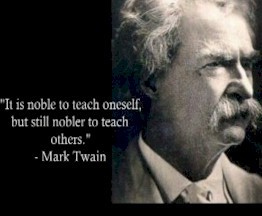
"The mediocre teacher tells. The good teacher explains. The superior teacher demonstrates. The great teacher inspires." - William Ward